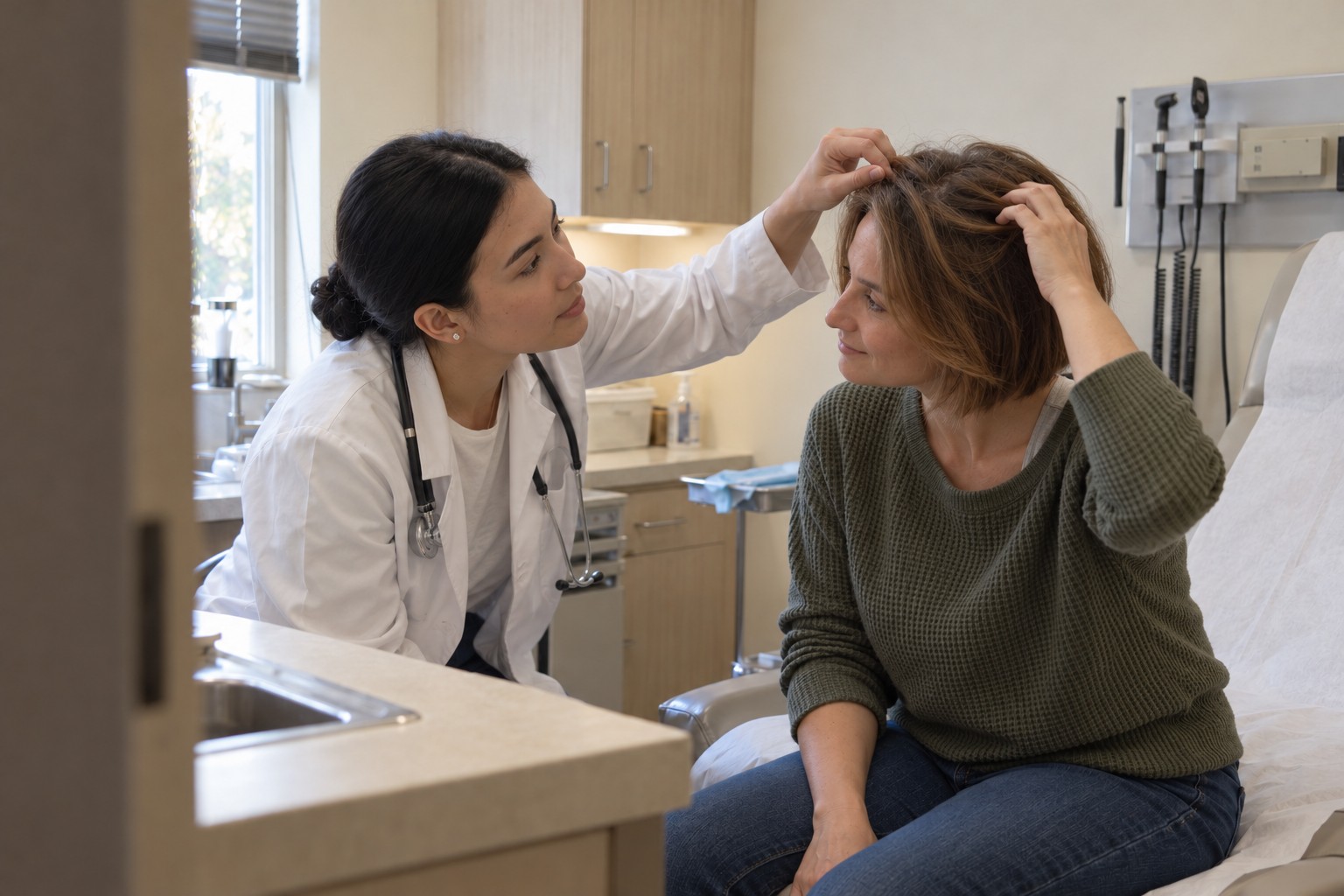
You might be standing there, staring at a rack of half-empty hair products, wondering again why your hair is thin.One product might alter the way your hair feels. Another might hide a wide part. But neither will help you understand what’s going on underneath.You can want answers and also want to keep looking like you, in the meantime. And you can do both. Describe what’s changed to your dermatologist, have the cause evaluated, and find a regimen that works for you.
Before buying another treatment, look at the pattern of hair loss
There are several reasons why a woman might say “I’m losing hair.” Maybe she sees more hair when she washes it. Her part might have grown wider. It might break off in small chunks. A dermatologist has to determine whether the patient is shedding, thinning or experiencing hair shaft damage, as these require different treatments.
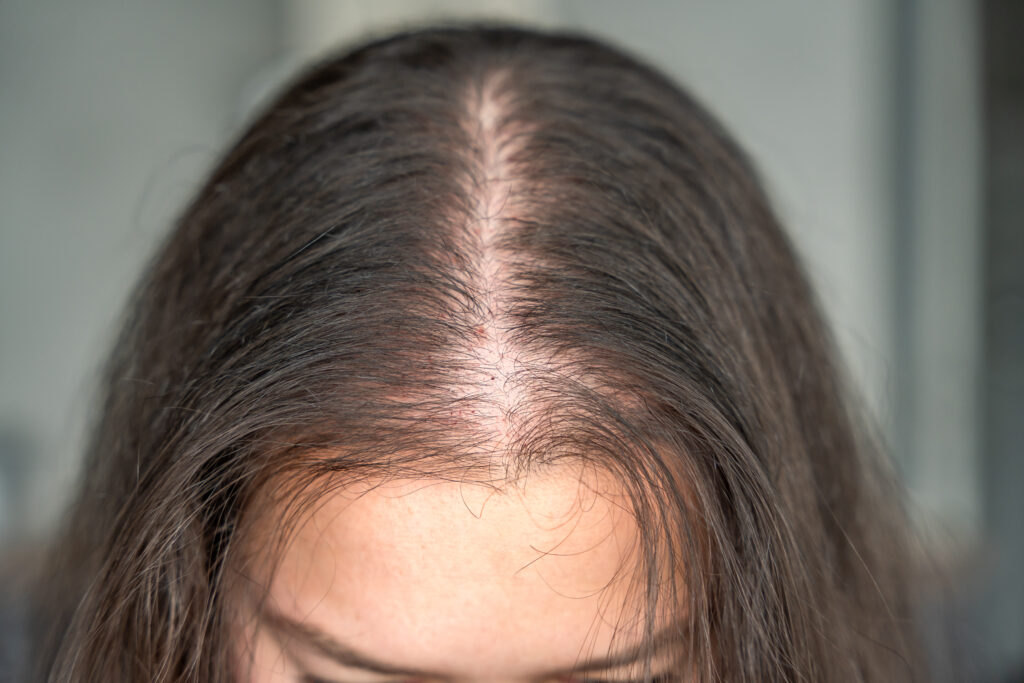
A wider part can point to female pattern hair loss
One common cause of hair loss in women is female pattern hair loss, which presents as gradual thinning across the top of the head. It’s also called female pattern baldness or hereditary hair loss. The hair follicles shrink and the resulting hair is thinner, and eventually, some of them stop growing hair. That’s why you may notice that your ponytail feels smaller when you haven’t shed a lot of hair.Mention any family history of hair loss. Tell your dermatologist about any thinning you’ve noticed since perimenopause or menopause, or alongside irregular periods or a thyroid problem. Hormones are one of several things that can disrupt the hair growth cycle, and the practice offers hair loss hormone testing that looks at androgens, thyroid function, estrogen and cortisol when the cause isn’t clear from the exam. The Miami Center for Dermatology has information about female pattern baldness, including how important it is to have a proper diagnosis.
A recent change may have an older trigger
After childbirth, illness, fever, surgery or a severe stressor, hair shedding may be excessive. It usually starts months after the triggering event. It is known as telogen effluvium, and it is shedding rather than true hair loss: the follicles are still working, they have just let go of more hair than usual at once.When you’re scheduling your appointment, look back further than the week you first noticed hair in your shower drain. Did you get sick earlier this year? Did you lose or gain significant weight? Are you taking any medications that could be causing this problem? If you do think a medication is responsible, don’t stop taking it until you talk with your prescribing doctor.Excessive shedding can also happen on top of another cause. Postpartum hormonal changes, for example, can trigger shedding in a woman who already has early pattern thinning.
When your scalp needs attention sooner
An appointment for hair thinning can help your doctor pinpoint the cause and discuss treatment options early.Hair loss that is sudden or patchy should be evaluated sooner rather than later, particularly if there is pain on the scalp, burning, severe itching, scaling or sores. There are other conditions, such as alopecia areata or a scalp infection, that can cause patchy hair loss. It’s important to let the doctor know if your eyebrows or eyelashes are falling out.Tell the scheduler what symptoms you’re experiencing when you call. Saying, “My hair is thinner,” will provide a different response than “I’ve developed a new bald patch that burns.”If the hair loss symptoms are severe or progressing rapidly, seek urgent medical evaluation instead of waiting for a routine cosmetic appointment. Some conditions can permanently destroy a hair follicle. In these instances, preserving the hair that remains is more important than waiting to see if a cosmetic product will work. Whether the hair grows back depends on the underlying cause.
Bring a timeline, even if the dates are approximate
It doesn’t have to be long, but include when you first noticed the change, where the loss is happening, and if your scalp seems different. Mention any recent illness, childbirth, diet, or weight changes. Include medications, including supplements (a photo of the label is easier to review than trying to recall what’s in that “hair vitamin”), recent treatments, and hair color or chemical services and styles. Extensions that pull tightly can cause some hair loss, and the hairstyles you typically wear can give clues. Providing this information helps your doctor figure out possible causes rather than assuming that all women who lose hair have the same issue.If you have older photos, these can also show a difference you’re having trouble describing. Pick one or two that show your part or hairline. If you want to take new photos, make sure you use the same part, camera distance, and lighting so that they are comparable. It isn’t necessary to take daily photos for this discussion.During the appointment, the doctor will discuss your medical history and examine your hair and scalp. Depending on those results, blood work or a scalp biopsy might be recommended. If a hormonal cause is suspected, that blood work may include hormone testing for thyroid function, androgens such as testosterone and DHT, estrogen and progesterone, and cortisol, along with nutritional markers.When you leave, make sure you know the answers to the following questions:
What is the most likely diagnosis, and are there any lingering uncertainties?
What should you do until your next appointment?
What changes should prompt you to contact your doctor sooner?
You might add, “This shedding is the most concerning thing to me,” or “I’d like to focus on the pain or itching before anything else.” What concerns you most might not be evident from looking at your scalp.
Make caring for thinning hair less complicated
What are the areas of your routine that are placing excessive stress on your delicate strands? Wash your hair with a mild shampoo, apply conditioner and be patient when combing through your locks. Limit the use of hot styling tools and set your blow dryer on a lower temperature. These are some of the American Academy of Dermatology’s suggestions for caring for thinning hair.Notice what a hairstyle does to your hair. Braids, buns, ponytails and extensions that pull your hair tightly can lead to hair loss known as traction alopecia. If you feel pain or stinging from wearing a certain style, don’t wait to have it fixed at your next appointment. With repeated tugging, this type of hair loss can become permanent.Having an easy-to-follow regimen helps you to explain it to your doctor. If you’ve started using five different products and notice scalp irritation, give your dermatologist all five product names instead of having to figure out which one is to blame.Watch out for supplements that promise faster, thicker hair growth. Sometimes there really is a nutrient deficiency that needs addressing, but taking nutrients without a medical reason can have adverse effects. In fact, too much of some vitamins and minerals can also cause hair loss. Before you order yet another bottle, ask if testing or a diet adjustment would be more appropriate.
Decide what your hair loss treatment should achieve
To answer the question “Will it work?”, you need to first know what success looks like. Is the aim to prevent further hair loss, stimulate hair growth, reduce scalp inflammation or monitor recovery after a shedding episode? How will you and your doctor measure success? If there is less shedding or new hair, those will be different signs of improvement.With female pattern hair loss, your dermatologist may recommend topical minoxidil. It can take several months to evaluate efficacy and ongoing use is required to keep its effects going. Ask about side effects, early shedding and how to apply. Tell your dermatologist if you’re pregnant, planning a pregnancy or breastfeeding before using any hair loss medication. The AAD specifically advises avoiding minoxidil in those circumstances.Hair transplantation may be another option for some women with pattern hair thinning. To be eligible, you must have adequate donor hair and a healthy recipient area that can support growth. Ask your dermatologist whether you have enough healthy donor hair to be a candidate.If testing shows a hormonal imbalance, the plan may look different. Treating a thyroid problem, managing PCOS or addressing a menopause-related shift can be part of the hair loss plan, sometimes alongside topical treatment rather than instead of it. Ask what the test results actually showed and how the proposed treatment addresses them.According to the Miami Center for Dermatology’s hair loss treatments information page, platelet-rich plasma (PRP) therapy entails drawing your blood, separating the blood and injecting the platelet rich portion into the scalp. The practice advises scheduling a consultation to determine which treatment is right for you based on your goals and health history.Should PRP be recommended, ask why it was selected for your condition, what level of improvement can realistically be expected, the potential side effects and the number of sessions you will likely require. Find out how much it will cost for the full proposed treatment plan including follow-ups rather than considering one session alone.
Make room for your appearance and your peace of mind
It’s also okay to change your part or opt for a bob, or try a wig or hairpiece, even before you see hair regrowth. It isn’t necessary to cover up sparse areas. The NHS advice about managing hair loss recognizes both possibilities. When considering a hairpiece, find out how it’s fixed in place, how it should be washed and whether you can trial the fit. Make sure clips aren’t tugging at delicate areas. Scarves and wigs should be comfortable rather than restrictive. If you use a topical medication on your scalp, ask how to integrate wearing a covering into your regular regimen.You can employ the same simple technique for deflecting unsolicited opinions: ‘I have an appointment and I’d rather not talk about it’ works fine. With relatives or acquaintances you might say, ‘I don’t need more treatment links, but I’d appreciate some company at my appointment.’If your sleep, work or relationships are affected by anxiety, let your doctor know. Psychotherapy or a support group may be appropriate, but ensure you’re in an environment where you feel free to raise your anxieties without being pushed towards purchasing a product or endorsing another person’s treatment of choice.
Leave yourself a clear next step
Treatment for hair loss in women may not show results for several months. Agree on when to follow up and how you will evaluate progress, such as comparing photographs taken with similar lighting and camera angles at different times. Make sure you know what steps to take if the medication causes irritation, is too expensive, or doesn’t work. These are signs that it’s time to reassess the treatment.You can request a consultation with Miami Center for Dermatology to discuss your observations. Come prepared with your timeline and the question you’re most anxious to have answered. The first visit should identify issues that must be dealt with immediately and those that you can wait on to check again later.
This mode enables people with epilepsy to use the website safely by eliminating the risk of seizures that result from flashing or blinking animations and risky color combinations.
Visually Impaired Mode
Improves website's visuals
This mode adjusts the website for the convenience of users with visual impairments such as Degrading Eyesight, Tunnel Vision, Cataract, Glaucoma, and others.
Cognitive Disability Mode
Helps to focus on specific content
This mode provides different assistive options to help users with cognitive impairments such as Dyslexia, Autism, CVA, and others, to focus on the essential elements of the website more easily.
ADHD Friendly Mode
Reduces distractions and improve focus
This mode helps users with ADHD and Neurodevelopmental disorders to read, browse, and focus on the main website elements more easily while significantly reducing distractions.
Blindness Mode
Allows using the site with your screen-reader
This mode configures the website to be compatible with screen-readers such as JAWS, NVDA, VoiceOver, and TalkBack. A screen-reader is software for blind users that is installed on a computer and smartphone, and websites must be compatible with it.
Online Dictionary
Readable Experience
Content Scaling
Default
Text Magnifier
Readable Font
Dyslexia Friendly
Highlight Titles
Highlight Links
Font Sizing
Default
Line Height
Default
Letter Spacing
Default
Left Aligned
Center Aligned
Right Aligned
Visually Pleasing Experience
Dark Contrast
Light Contrast
Monochrome
High Contrast
High Saturation
Low Saturation
Adjust Text Colors
Adjust Title Colors
Adjust Background Colors
Easy Orientation
Mute Sounds
Hide Images
Hide Emoji
Reading Guide
Stop Animations
Reading Mask
Highlight Hover
Highlight Focus
Big Dark Cursor
Big Light Cursor
Cognitive Reading
Virtual Keyboard
Navigation Keys
Voice Navigation
Accessibility Statement
miamicenterfordermatology.com
November 6, 2026
Compliance status
We firmly believe that the internet should be available and accessible to anyone, and are committed to providing a website that is accessible to the widest possible audience,
regardless of circumstance and ability.
To fulfill this, we aim to adhere as strictly as possible to the World Wide Web Consortium’s (W3C) Web Content Accessibility Guidelines 2.1 (WCAG 2.1) at the AA level.
These guidelines explain how to make web content accessible to people with a wide array of disabilities. Complying with those guidelines helps us ensure that the website is accessible
to all people: blind people, people with motor impairments, visual impairment, cognitive disabilities, and more.
This website utilizes various technologies that are meant to make it as accessible as possible at all times. We utilize an accessibility interface that allows persons with specific
disabilities to adjust the website’s UI (user interface) and design it to their personal needs.
Additionally, the website utilizes an AI-based application that runs in the background and optimizes its accessibility level constantly. This application remediates the website’s HTML,
adapts Its functionality and behavior for screen-readers used by the blind users, and for keyboard functions used by individuals with motor impairments.
If you’ve found a malfunction or have ideas for improvement, we’ll be happy to hear from you. You can reach out to the website’s operators by using the following email
Screen-reader and keyboard navigation
Our website implements the ARIA attributes (Accessible Rich Internet Applications) technique, alongside various different behavioral changes, to ensure blind users visiting with
screen-readers are able to read, comprehend, and enjoy the website’s functions. As soon as a user with a screen-reader enters your site, they immediately receive
a prompt to enter the Screen-Reader Profile so they can browse and operate your site effectively. Here’s how our website covers some of the most important screen-reader requirements,
alongside console screenshots of code examples:
Screen-reader optimization: we run a background process that learns the website’s components from top to bottom, to ensure ongoing compliance even when updating the website.
In this process, we provide screen-readers with meaningful data using the ARIA set of attributes. For example, we provide accurate form labels;
descriptions for actionable icons (social media icons, search icons, cart icons, etc.); validation guidance for form inputs; element roles such as buttons, menus, modal dialogues (popups),
and others. Additionally, the background process scans all the website’s images and provides an accurate and meaningful image-object-recognition-based description as an ALT (alternate text) tag
for images that are not described. It will also extract texts that are embedded within the image, using an OCR (optical character recognition) technology.
To turn on screen-reader adjustments at any time, users need only to press the Alt+1 keyboard combination. Screen-reader users also get automatic announcements to turn the Screen-reader mode on
as soon as they enter the website.
These adjustments are compatible with all popular screen readers, including JAWS and NVDA.
Keyboard navigation optimization: The background process also adjusts the website’s HTML, and adds various behaviors using JavaScript code to make the website operable by the keyboard. This includes the ability to navigate the website using the Tab and Shift+Tab keys, operate dropdowns with the arrow keys, close them with Esc, trigger buttons and links using the Enter key, navigate between radio and checkbox elements using the arrow keys, and fill them in with the Spacebar or Enter key.Additionally, keyboard users will find quick-navigation and content-skip menus, available at any time by clicking Alt+1, or as the first elements of the site while navigating with the keyboard. The background process also handles triggered popups by moving the keyboard focus towards them as soon as they appear, and not allow the focus drift outside it.
Users can also use shortcuts such as “M” (menus), “H” (headings), “F” (forms), “B” (buttons), and “G” (graphics) to jump to specific elements.
Disability profiles supported in our website
Epilepsy Safe Mode: this profile enables people with epilepsy to use the website safely by eliminating the risk of seizures that result from flashing or blinking animations and risky color combinations.
Visually Impaired Mode: this mode adjusts the website for the convenience of users with visual impairments such as Degrading Eyesight, Tunnel Vision, Cataract, Glaucoma, and others.
Cognitive Disability Mode: this mode provides different assistive options to help users with cognitive impairments such as Dyslexia, Autism, CVA, and others, to focus on the essential elements of the website more easily.
ADHD Friendly Mode: this mode helps users with ADHD and Neurodevelopmental disorders to read, browse, and focus on the main website elements more easily while significantly reducing distractions.
Blindness Mode: this mode configures the website to be compatible with screen-readers such as JAWS, NVDA, VoiceOver, and TalkBack. A screen-reader is software for blind users that is installed on a computer and smartphone, and websites must be compatible with it.
Keyboard Navigation Profile (Motor-Impaired): this profile enables motor-impaired persons to operate the website using the keyboard Tab, Shift+Tab, and the Enter keys. Users can also use shortcuts such as “M” (menus), “H” (headings), “F” (forms), “B” (buttons), and “G” (graphics) to jump to specific elements.
Additional UI, design, and readability adjustments
Font adjustments – users, can increase and decrease its size, change its family (type), adjust the spacing, alignment, line height, and more.
Color adjustments – users can select various color contrast profiles such as light, dark, inverted, and monochrome. Additionally, users can swap color schemes of titles, texts, and backgrounds, with over seven different coloring options.
Animations – person with epilepsy can stop all running animations with the click of a button. Animations controlled by the interface include videos, GIFs, and CSS flashing transitions.
Content highlighting – users can choose to emphasize important elements such as links and titles. They can also choose to highlight focused or hovered elements only.
Audio muting – users with hearing devices may experience headaches or other issues due to automatic audio playing. This option lets users mute the entire website instantly.
Cognitive disorders – we utilize a search engine that is linked to Wikipedia and Wiktionary, allowing people with cognitive disorders to decipher meanings of phrases, initials, slang, and others.
Additional functions – we provide users the option to change cursor color and size, use a printing mode, enable a virtual keyboard, and many other functions.
Browser and assistive technology compatibility
We aim to support the widest array of browsers and assistive technologies as possible, so our users can choose the best fitting tools for them, with as few limitations as possible. Therefore, we have worked very hard to be able to support all major systems that comprise over 95% of the user market share including Google Chrome, Mozilla Firefox, Apple Safari, Opera and Microsoft Edge, JAWS and NVDA (screen readers).
Notes, comments, and feedback
Despite our very best efforts to allow anybody to adjust the website to their needs. There may still be pages or sections that are not fully accessible, are in the process of becoming accessible, or are lacking an adequate technological solution to make them accessible. Still, we are continually improving our accessibility, adding, updating and improving its options and features, and developing and adopting new technologies. All this is meant to reach the optimal level of accessibility, following technological advancements. For any assistance, please reach out to